
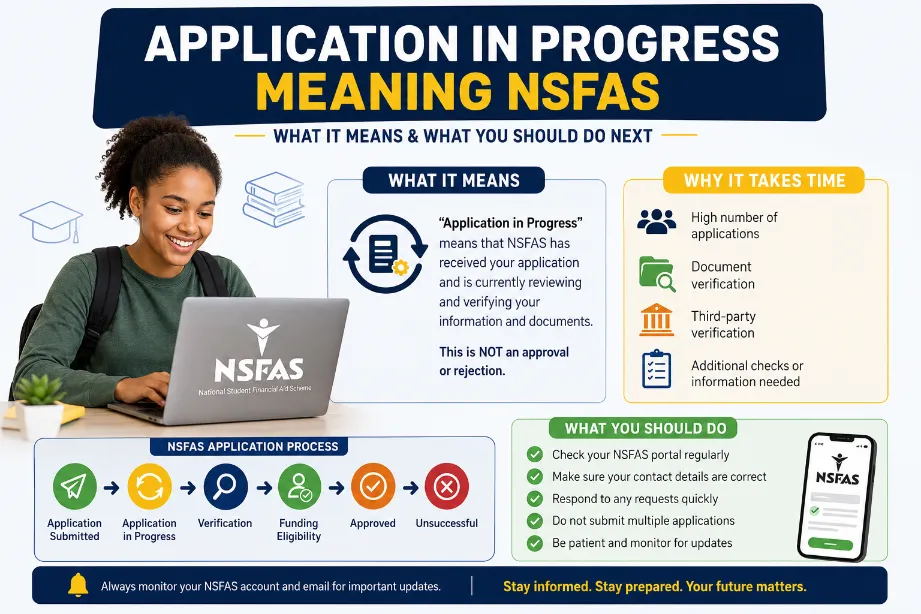
Application in Progress Meaning NSFAS
If your NSFAS portal displays Application in Progress Meaning NSFAS, it simply means that your application has been successfully received and is currently being processed. At this stage, the National Student Financial Aid Scheme (NSFAS) is reviewing the information and supporting documents you submitted before making a funding decision.
This status does not indicate approval or rejection. Instead, it confirms that your application is moving through the official assessment process. Understanding each application status can help reduce unnecessary stress and ensure you know what steps, if any, you need to take.
What Does “Application in Progress” Mean?
When your application status reads Application in Progress, NSFAS is actively evaluating your submission. During this process, officials verify several important details, including:
- Your identity and personal information.
- Household income eligibility.
- Academic admission or registration details.
- Citizenship or residency requirements.
- Supporting documents submitted with your application.
Only after these checks are completed will your application move to the next stage.
Why Does Your Application Stay in Progress?
There are several reasons why your application may remain in this status for some time.
1. High Number of Applications
- NSFAS receives hundreds of thousands of applications every funding cycle. Processing each application carefully takes time.
2. Document Verification
Officials must verify documents such as:
- Identity documents
- Proof of income (where required)
- Consent forms
- Other supporting documents
If verification takes longer, your application status may remain unchanged.
3. Third-Party Verification
- NSFAS works with government departments and educational institutions to verify applicant information. Waiting for confirmation from these organizations may extend processing times.
4. Additional Checks
- Some applications require further review due to missing information or discrepancies that need clarification.
Stages of the NSFAS Application Process
Most applications move through several stages before a final decision.
| Application Status | Meaning |
|---|---|
| Application Submitted | NSFAS has received your application. |
| Application in Progress | Your application is being reviewed and verified. |
| Verification | Documents and eligibility are being checked. |
| Funding Eligibility | NSFAS determines whether you qualify. |
| Approved | Funding has been granted. |
| Unsuccessful | Application did not meet funding requirements. |
Not every application follows the exact same timeline, but these are the most common stages.
How Long Does “Application in Progress” Last?
There is no fixed timeframe because processing depends on factors such as:
- Number of applications received
- Accuracy of submitted information
- Completion of document verification
- Institutional confirmation
- Internal review procedures
Some applications progress quickly, while others may require additional time.
Should You Be Concerned?
In most situations, no.
An application remaining “in progress” is a normal part of the assessment process. It generally means NSFAS is still reviewing your information.
However, you should monitor your application if:
- The status remains unchanged for an unusually long period.
- NSFAS requests additional documents.
- Your contact information changes.
- Your institution requests updated registration details.
What Should You Do While Waiting?
Instead of submitting multiple applications, follow these practical steps.
Check Your NSFAS Portal Regularly
- Log in periodically to monitor any updates or requests.
Monitor Your Email and SMS
- Important notifications may be sent through email or text message.
Ensure Your Contact Details Are Correct
- Incorrect contact information can delay communication.
Keep Your Documents Ready
- If additional documentation is requested, submit it as soon as possible.
Avoid Duplicate Applications
- Submitting another application can create unnecessary complications.
Common Reasons for Delays
Several factors can slow the review process.
- Missing supporting documents
- Incorrect personal information
- Identity verification issues
- Delayed institutional confirmation
- High application volumes
- Additional eligibility reviews
Most delays are administrative rather than indications that your application has been rejected.
Can You Update Your Application?
This depends on the current stage of processing and NSFAS policies.
Generally, students should:
- Follow any instructions provided through their NSFAS account.
- Upload requested documents promptly.
- Respond quickly if contacted by NSFAS.
- Avoid changing information unless instructed to do so.
Tips for a Smooth Application Process
To improve the likelihood of efficient processing:
- Submit applications before deadlines.
- Upload clear and readable documents.
- Double-check all personal information.
- Use an active email address.
- Keep your mobile number updated.
- Save copies of all submitted documents.
- Track your application regularly.
Understanding the Application in Progress Meaning NSFAS can help you remain informed throughout the funding process. This status simply indicates that NSFAS is reviewing your application and verifying the information you submitted. It is a standard part of the application journey and should not be interpreted as either approval or rejection.
The best approach is to monitor your application regularly, ensure your contact details remain up to date, respond promptly to any document requests, and wait for the official outcome. By staying informed and following NSFAS guidance, you can avoid unnecessary delays and be prepared for the next stage of the funding process.
Does “Application in Progress” Mean I Will Receive Funding?
No. It only means your application is currently under review. Funding decisions are made after all eligibility checks have been completed.
Can My Status Change Without Notice?
Yes. Your application status may update once a review stage has been completed.
Should I Contact NSFAS Immediately?
Not necessarily. If your application is still within the normal processing period, it is generally best to continue monitoring your account. Contact NSFAS only if you receive a request for additional information or if your application appears delayed beyond the usual processing timeframe.
What Happens After “Application in Progress”?
Your application may move to verification, eligibility assessment, approval, or another review stage depending on the outcome of the evaluation.